
Your dog spots another dog across the street. Their body stiffens, the leash tightens, and suddenly they’re barking, lunging, or spinning at the end of the lead. Leash reactive dog training is not about forcing your dog to “behave” through pressure. It’s about understanding why the reaction happens, then teaching your dog a safer pattern before they lose control.
This guide focuses on a practical, walk-based approach for owners dealing with dog lunging on leash, barking, pulling, and on-leash reactivity around dogs, people, bikes, cars, or other triggers.
Key Takeaways
- Leash reactivity is not always aggression. Many leash reactive dogs are scared, frustrated, overstimulated, or unsure what to do.
- The goal is not to make your dog ignore the world immediately. The first goal is to keep them under threshold so they can think and learn.
- Distance is one of your most useful training tools. If your dog is already barking and lunging, you are too close to the trigger.
- Loose leash walking and reactivity work are connected, but they are not the same skill.
- Progress comes from planned repetitions, not from “testing” your dog on difficult walks every day.
What Leash Reactivity Really Means
Leash reactivity is an over-the-top response to something your dog sees, hears, or smells while restrained by a leash. That reaction may look like barking, growling, lunging, whining, freezing, jumping, pulling, or refusing to move.
The trigger depends on the dog. For one dog, it may be another dog. For another, it may be a jogger, stroller, delivery truck, cyclist, child, or person in a hat. Some dogs react only when the trigger moves toward them. Others react when they cannot get closer.
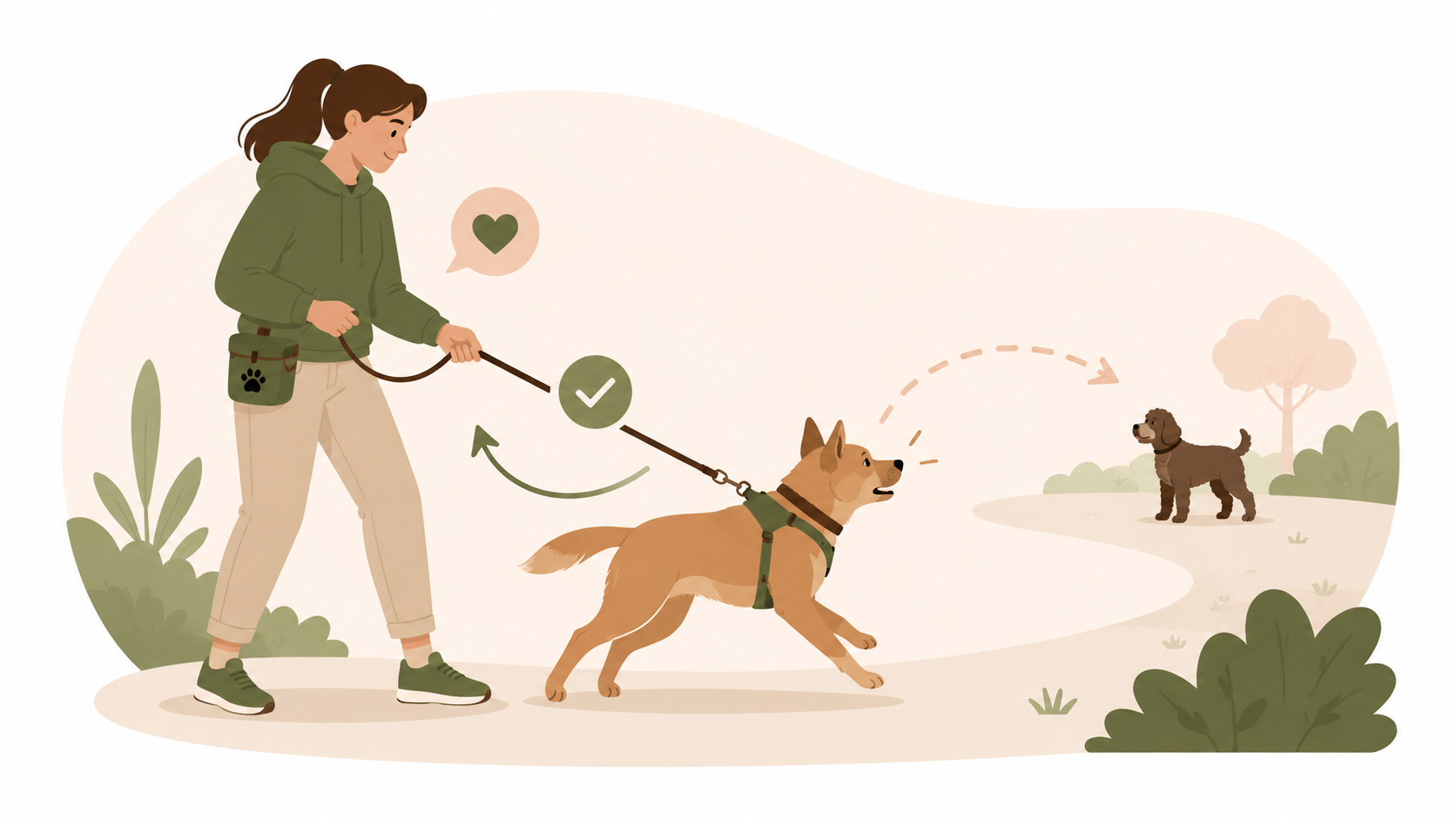
That distinction matters. A dog that wants space and a dog that wants access can look nearly identical at the end of the leash.
Cornell’s Riney Canine Health Center explains that reactive dogs are not necessarily aggressive dogs, but reactivity can become more serious if it is ignored or repeatedly rehearsed. That is why early, structured training matters, especially when the behavior is intense or escalating.
A simple way to think about it is this: your dog is not giving you a hard time on purpose. They are having a hard time and showing it with their body.
Why Dogs Lunge, Bark, or Growl on Leash
Most leash aggression training fails when it assumes every barking dog is trying to dominate or attack. On-leash reactivity is more often driven by emotion, learning history, and the physical restriction of the leash.
Fear or uncertainty
A fearful dog may lunge because the behavior works. If your dog barks at another dog and that dog eventually moves away, your dog may learn, “Barking makes scary things leave.”
This is one reason punishment can make the problem worse. If the dog already feels worried, adding leash pops, yelling, or harsh corrections may increase the negative association with the trigger.
The American Veterinary Society of Animal Behavior recommends reward-based training methods for dog training and behavior modification, noting that training should focus on reinforcing desired behaviors and addressing the emotional conditions behind unwanted behavior.
Frustration from being restrained
Not every reactive dog is scared. Some dogs are social, excited, and frustrated because the leash prevents them from greeting or chasing.
This often shows up in dogs that were allowed to greet every dog on leash as puppies. They learned that seeing a dog means rushing forward. Later, when the owner tries to stop that habit, the dog becomes louder and more frantic.
A frustrated greeter may whine, bounce, pull, and bark in a higher-pitched way. They may look loose and wiggly once they finally reach the other dog. That does not mean the behavior is safe. A hard, direct approach on leash can still create conflict.
Overstimulation and poor recovery
Some dogs do fine for the first ten minutes of a walk, then react at everything after one difficult moment. This is common with young, energetic, or sensitive dogs.
Think of your dog’s nervous system like a cup. A squirrel, barking dog, loud truck, and tight leash all add water to the cup. Once it overflows, even a small trigger can cause a big reaction.
This is why reactive training is not only about the one dog across the street. Sleep, exercise, predictability, enrichment, and calm recovery all affect how much your dog can handle.
Leash Reactive Dog Training Starts Before the Walk
You cannot train well if every walk begins with chaos at the front door. The first part of leash reactive dog training is setting up walks so your dog has a real chance to succeed.
Start by changing the goal of the walk. For now, the goal is not distance. It is quality. A calm 12-minute training walk is more useful than a 45-minute route where your dog reacts six times.
Pick routes with escape options. Wide streets, quiet school parking lots after hours, empty fields, business parks on weekends, and large open areas are better than narrow sidewalks where triggers appear suddenly.
The ASPCA’s leash reactivity guidance recommends staying far enough away from other dogs that your dog can notice them without reacting, then progressing gradually over days or weeks. That “far enough away” distance is different for every dog.
Before leaving the house, prepare your equipment:
Training Item And Why It Helps
A six-foot leash: Gives control without the constant tension of a retractable leash.
A well-fitted harness or flat collar: Keeps your dog secure without adding unnecessary discomfort.
High-value treats: Helps your dog build a better association with triggers.
Treat pouch: Keeps timing fast, which matters during reactivity work.
Planned route: Reduces surprise encounters and gives you room to turn away.
Avoid relying on equipment to “fix” the behavior. Tools can support safety, but they do not teach your dog how to feel and respond differently.
If you are already working on obedience foundations, pair this with structured training support. A dog that understands marker words, recall, place, and leash pressure basics will usually progress faster. For owners who need help building those skills, the site’s training programs can provide a more structured starting point.
A Step-by-Step Training Plan for Safer Walks
A good plan should tell you what to do before, during, and after your dog sees a trigger. The mistake many owners make is waiting until the dog explodes, then trying to correct the reaction.
By then, the teachable moment is usually gone.
Step 1: Find your dog’s working distance
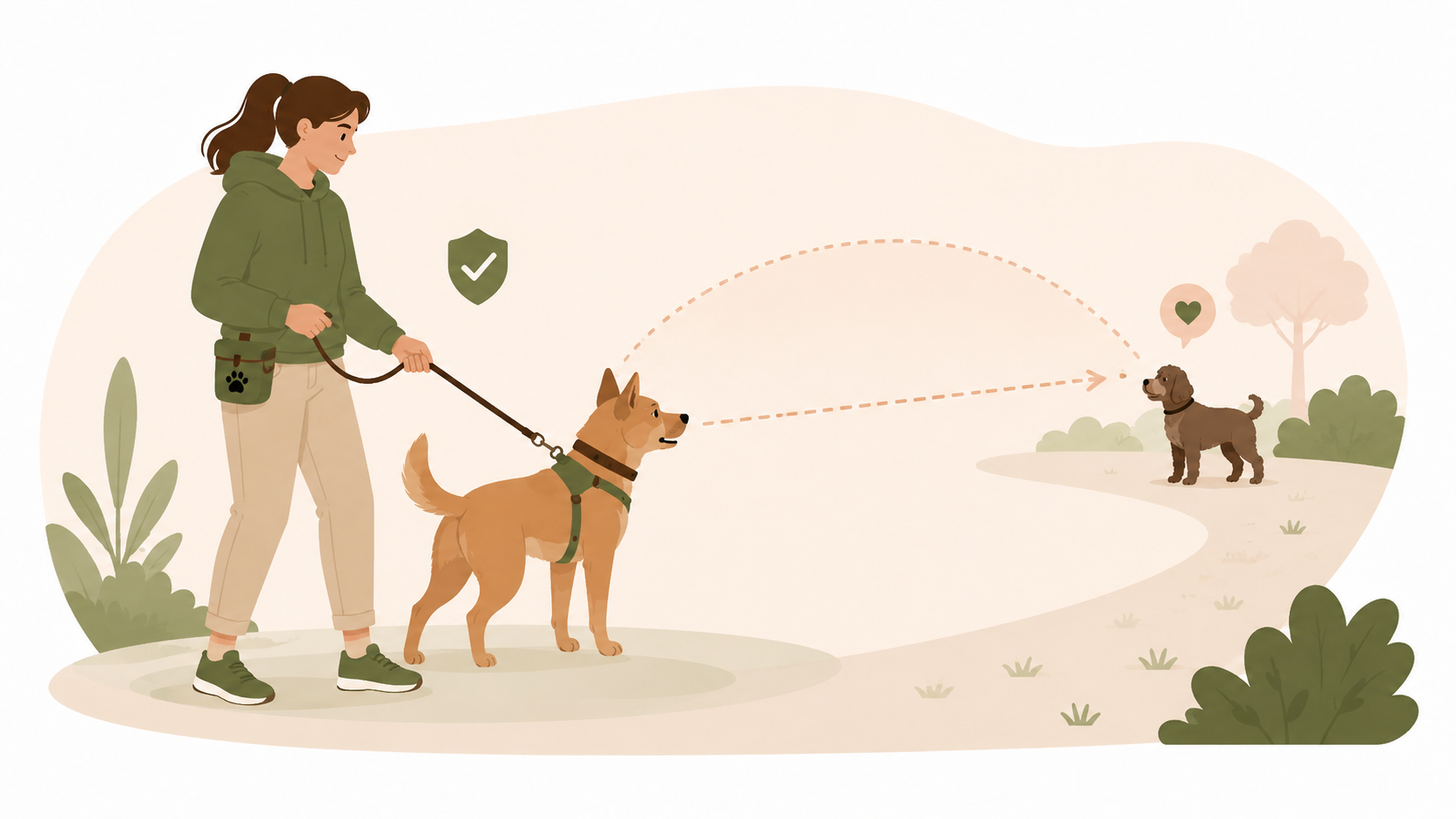
Your dog’s working distance is the distance where they can see the trigger but still take food, respond to their name, and move with you.
Use a simple traffic-light system:
Zone
What Your Dog Looks Like
What You Should Do
Green zone -Notices the trigger but can eat, turn, sniff, or respond. - Train here. Reward calm noticing and checking in.
Yellow zone - Stiff body, staring, closed mouth, slower response, leaning forward. - Create distance before barking starts.
Red zone - Barking, lunging, spinning, growling, or unable to hear you. - Stop training. Move away safely and reset.
The green zone is where learning happens. The red zone is where management happens.
A practical example: if your dog reacts to another dog at 30 feet but can calmly watch at 60 feet, start at 70 feet. That extra space gives you room for real life, because the other dog may move, bark, or turn toward you.
Step 2: Mark the trigger, then reward the check-in
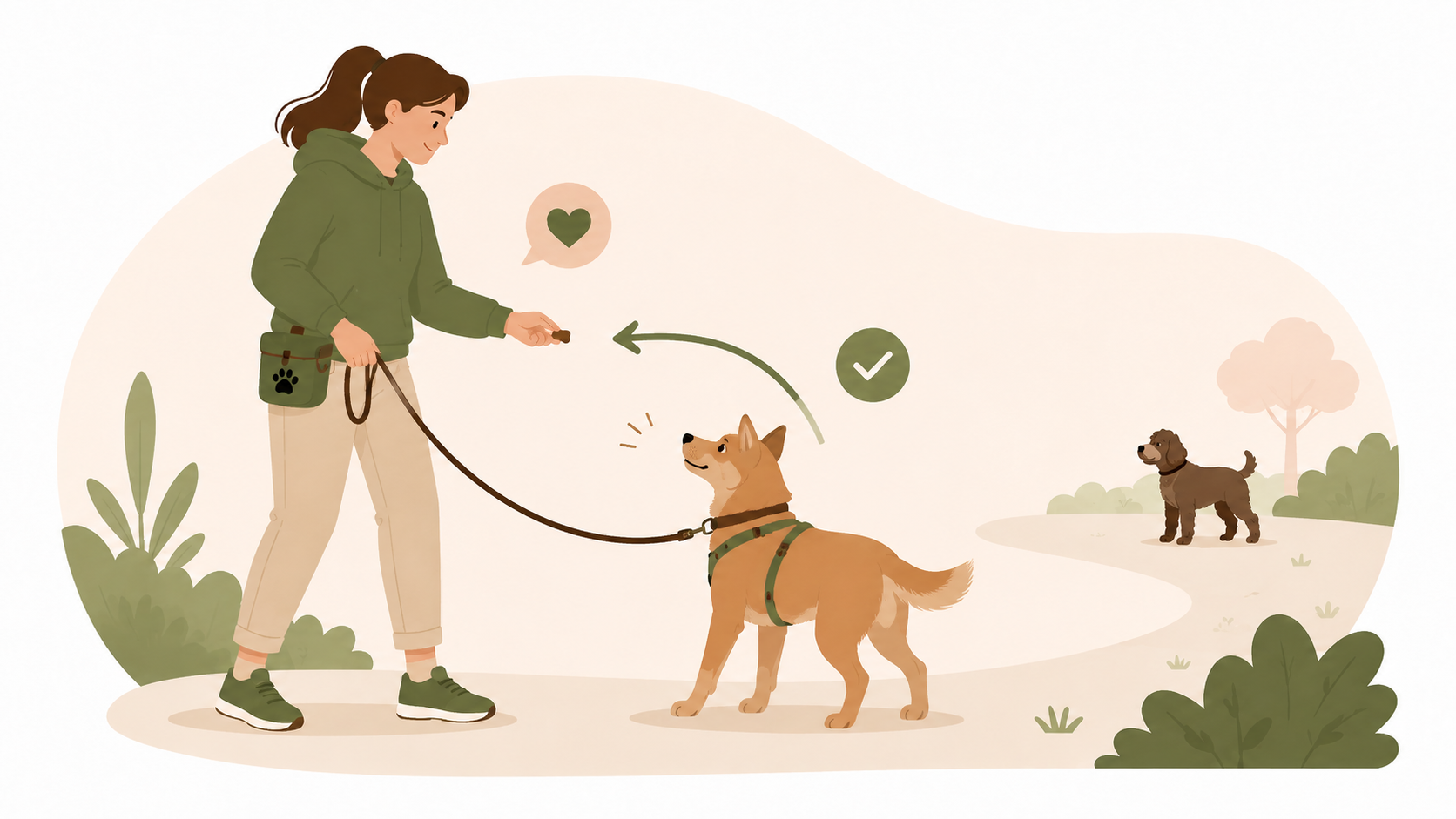
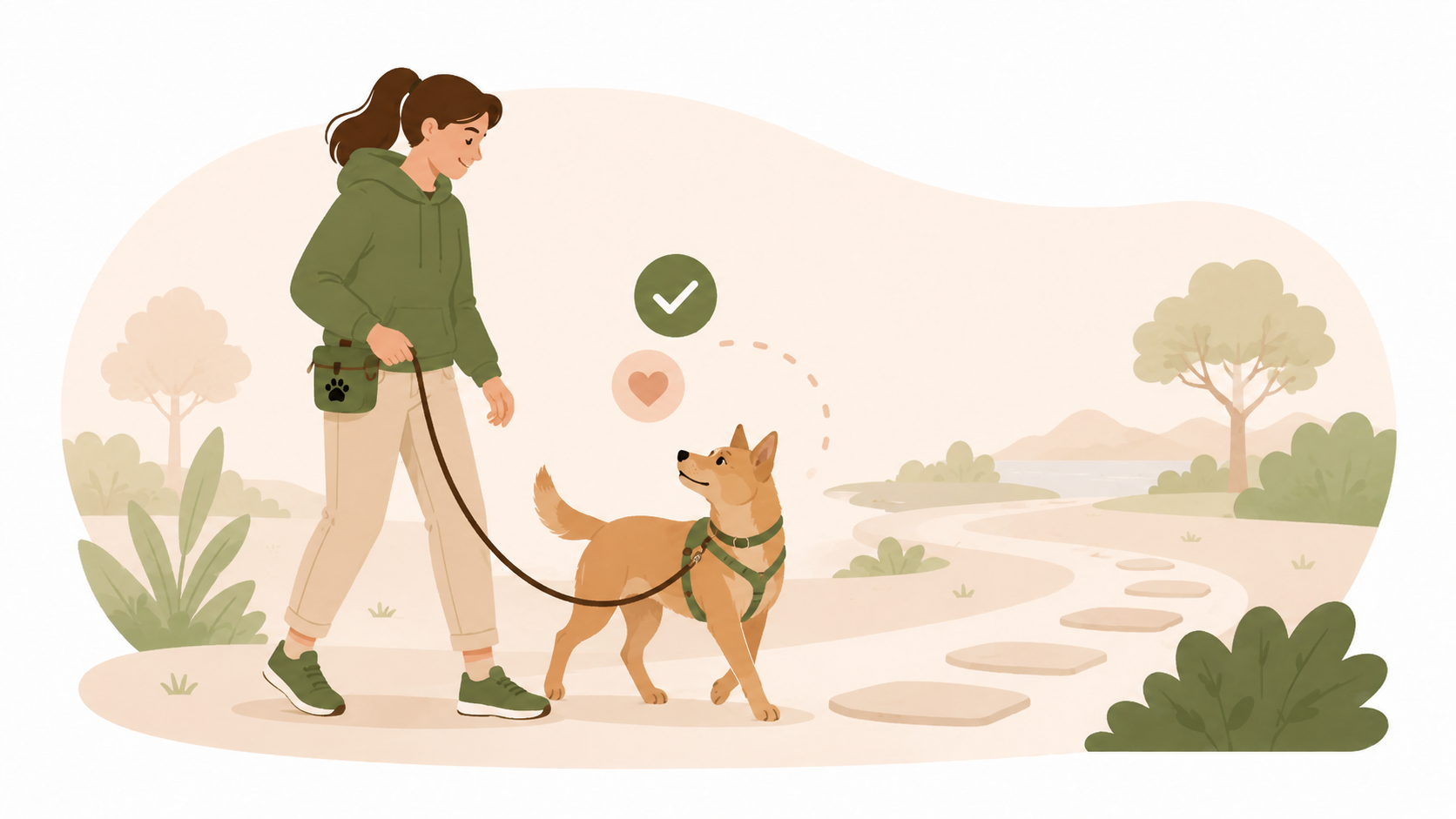
One of the most useful patterns for leash reactive dogs is teaching them that seeing a trigger predicts checking back with you.
Here is the basic sequence:
- Your dog sees the trigger at a safe distance.
- You mark the moment calmly with “yes” or a clicker.
- You feed a high-value treat near your leg.
- You move away if your dog starts to stiffen or stare too long.
At first, you may mark as soon as your dog notices the trigger. Over time, many dogs begin to look at the trigger, then look back at you on their own. That voluntary check-in is the behavior you want to grow.
Do not ask for too much too soon. If your dog cannot take food, they are probably too close, too stressed, or too overstimulated.
Step 3: Teach an emergency U-turn
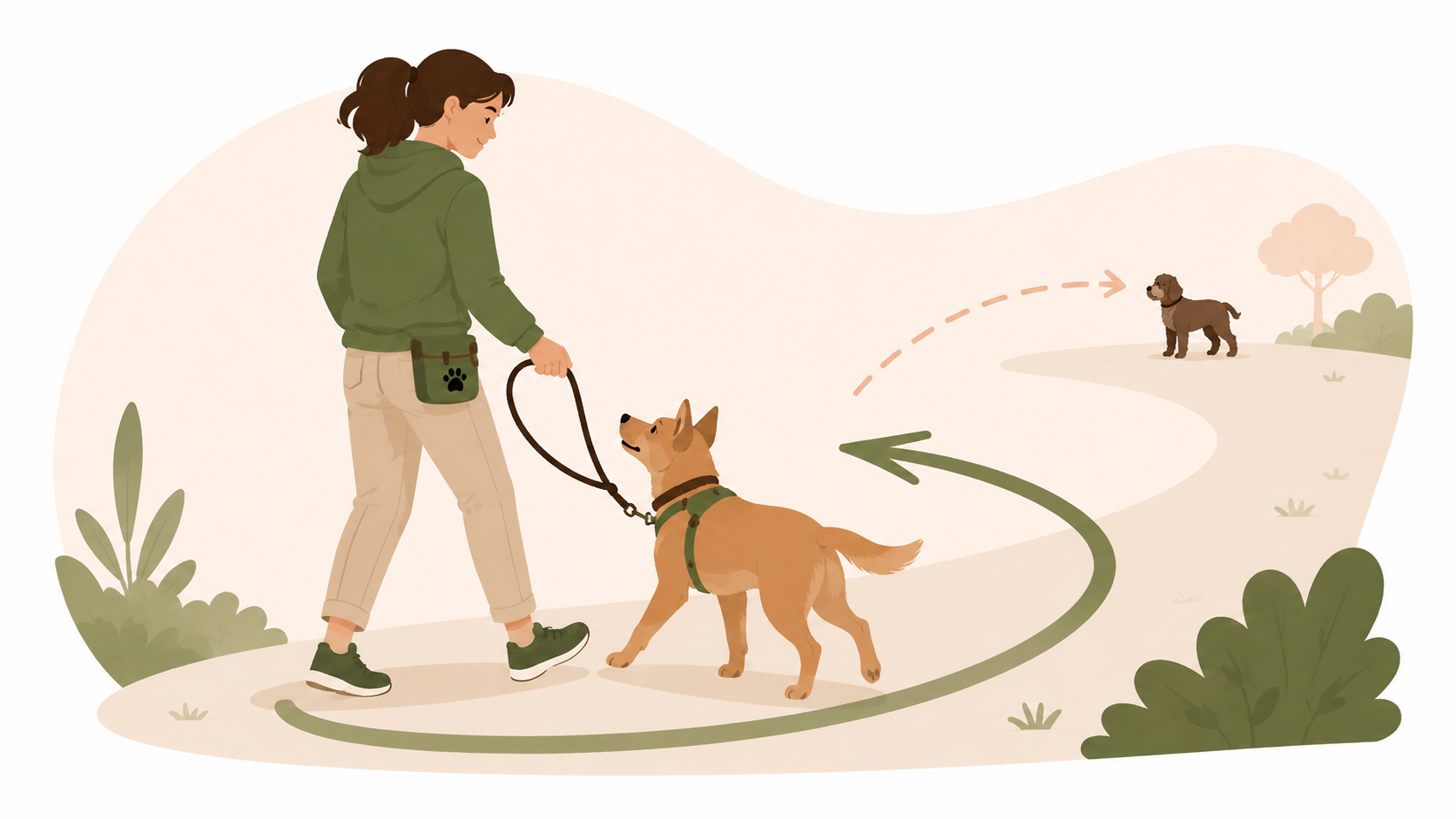
A U-turn is not failure. It is a safety skill.
Practice it away from triggers first. Say a cue like “this way,” turn your body, and reward your dog for moving with you. Make it light and predictable. Do this in the driveway, yard, hallway, or quiet street before using it on a real walk.
When a trigger appears too close, use the cue once and move. Do not stop to lecture your dog. Do not wait for the explosion. Your goal is to get out before your dog feels the need to react.
This is especially important in neighborhoods where loose dogs, narrow sidewalks, and blind corners make perfect setups impossible.
Step 4: Build loose leash walking separately
Loose leash walking helps your dog stay connected to you, but it should be practiced away from major triggers at first.
Reactive dogs often pull harder because the leash is already tight when the trigger appears. That tension travels through the leash and can increase arousal. If your dog learns that a loose leash is the normal walking position, you have more communication before things escalate.
Practice in low-distraction areas. Reward your dog for walking near you, checking in, and moving with the leash instead of bracing against it. Keep sessions short. Three focused five-minute sessions often beat one long, frustrating walk.
If your dog has completed initial training but needs help keeping skills sharp around distractions, continuing training support can be useful for progressing from quiet practice to real-world walks.
Step 5: Keep a simple reaction log
You do not need a complicated spreadsheet. A note on your phone works.
Track four things after each walk:
- What triggered the reaction?
- How far away was it?
- What did your dog do before barking or lunging?
- What helped them recover?
Patterns appear quickly. You may learn that your dog reacts only on narrow sidewalks, only after dark, only when the other dog stares, or only after a stressful day.
That information is gold. It tells you where to train, what to avoid for now, and what your dog needs next.
When to Get Professional Help
Some leash reactive dogs improve with careful owner-led work. Others need professional help, especially when safety is a concern.
Get support sooner if your dog has bitten, redirected onto the leash or handler, broken equipment, injured another dog, or escalated from barking to snapping. You should also seek help if your dog’s reactions are getting more intense despite your efforts.
Professional support is also valuable when you cannot read your dog’s body language clearly. Many reactions start before the bark: weight shift, hard staring, closed mouth, high tail, low tail, scanning, freezing, or refusing food.
A good trainer should not promise an instant cure. They should ask about triggers, distance, bite history, daily routine, equipment, and what happens before and after the reaction. They should also explain how they will keep your dog under threshold while building better skills.
If you are comparing options, a guide like choosing a local dog trainer can help you ask more specific questions before booking a first session.
Leash reactivity is stressful, but it is not hopeless. The turning point usually comes when owners stop trying to win a battle at the end of the leash and start changing the setup, distance, timing, and reinforcement history. Your dog does not need to love every trigger. They need a safer, calmer pattern they can repeat.
FAQs
What is the difference between leash reactivity and leash aggression?
Leash reactivity means a dog overreacts to a trigger while on leash. Leash aggression usually implies intent to threaten or harm, but the two can look similar. A qualified trainer can help assess whether your dog is fearful, frustrated, defensive, or truly aggressive.
Can leash reactive dogs be fixed completely?
Many leash reactive dogs improve significantly, but “fixed” depends on the dog, history, trigger type, and owner consistency. Some dogs become calm around previous triggers, while others still need smart management in crowded areas. The goal is safer, more predictable walks.
Should I let my reactive dog greet other dogs on leash?
Usually, no. On-leash greetings can create tension because both dogs have limited movement and cannot communicate naturally. For reactive dogs, repeated leash greetings often increase frustration and pulling because the dog learns that seeing another dog means direct access.
What treats work best for leash reactive dog training?
Use soft, high-value food your dog can eat quickly, such as small pieces of chicken, cheese, or training treats. Dry biscuits may be too slow or boring in difficult environments. If your dog refuses even favorite food, increase distance from the trigger.
Is loose leash walking enough to stop reactivity?
Loose leash walking helps, but it is not the whole solution. Reactivity work also needs trigger distance, counterconditioning, recovery skills, and better handler timing. A dog can walk nicely in quiet areas and still react when a trigger appears too close.
How long does leash reactive dog training take?
Some dogs show improvement in a few weeks, while others need months of steady practice. The timeline depends on how often the dog rehearses reactions, how intense the triggers are, and whether training stays below threshold. Progress is usually faster when walks are planned instead of left to chance.
What should I do if my dog reacts during a walk?
Create distance as calmly as possible. Use a practiced U-turn, move behind a visual barrier, or cross the street if it is safe. Do not force your dog to sit and watch the trigger while they are already barking or lunging, because that usually increases stress rather than teaching calm behavior.