
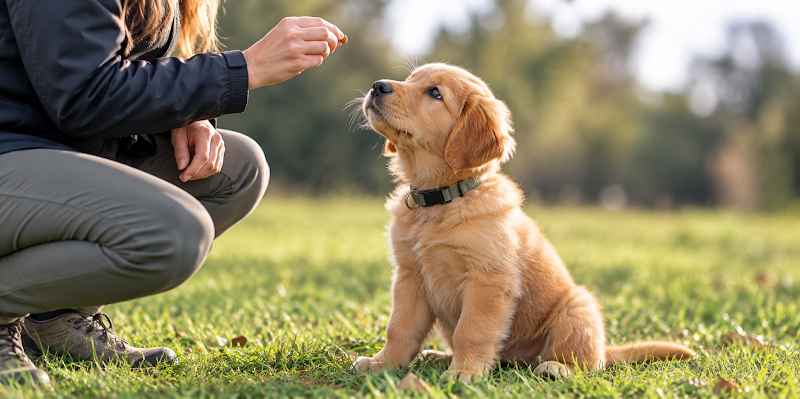
Puppies don't need to reach a certain birthday before they can begin learning. Training starts from the moment they come home, while a structured class can often begin around eight weeks when the puppy is healthy and your veterinarian agrees it's appropriate. For most owners asking about the best age to start dog training, the more useful question is what kind of training fits the puppy's current developmental stage.
Starting early can make everyday skills such as handling, settling, recall, leash walking, and polite greetings part of normal life before unwanted habits have months to become established. But early doesn't mean rushing a puppy into situations they aren't ready to handle.
Key Takeaways
- For many puppies, formal classes can begin at about eight weeks, subject to vaccination requirements and veterinary guidance.
- Training at home can begin as soon as your puppy arrives.
- The first few months are especially important for positive exposure to people, environments, handling, and everyday experiences.
- Age isn't the only consideration. Health, confidence, stress level, and the class environment matter too.
- Dogs that missed puppy classes aren't "too old." Adolescent and adult dogs can still learn obedience, manners, and new routines.
What is the best age to start dog training?
For many puppies, around eight weeks old is a practical starting point for formal puppy training classes. The American Kennel Club notes that training may begin after a puppy's first round of vaccinations, with veterinary approval, and some puppy programs accept dogs from about eight weeks onward.
That doesn't mean you should wait until eight weeks to introduce learning. Breeders may begin appropriate handling and early experiences before puppies go home, and owners can begin household training immediately after bringing a puppy home.
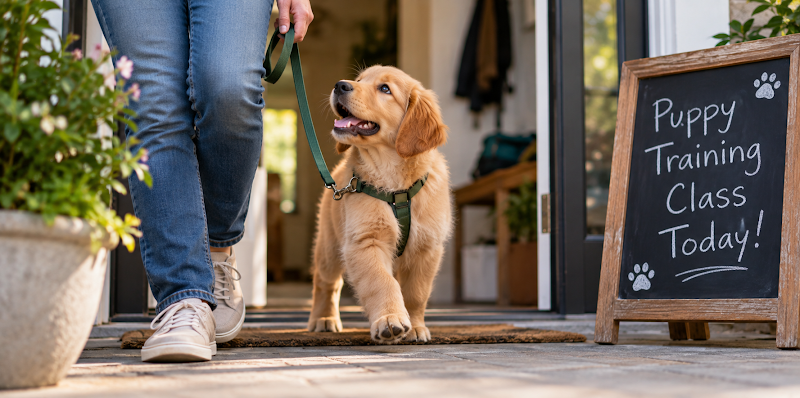
At this age, "training" shouldn't mean long obedience drills. A young puppy has a short attention span and is still learning how the household works. Useful early lessons include:
- Responding to their name and checking in with you.
- Going outside on a consistent potty schedule.
- Getting comfortable with a crate or designated resting area.
- Following a food lure into simple positions such as sit.
- Coming toward you when encouraged.
- Accepting gentle handling of paws, ears, collar, and body.
- Experiencing new surfaces, sounds, people, and environments without being overwhelmed.
The American Veterinary Society of Animal Behavior (AVSAB) describes the first three months of life as the primary socialization period and recommends safe socialization before a puppy is fully vaccinated rather than postponing all exposure until the vaccination series is complete. The organization also advises appropriate vaccination, health screening, clean class environments, and avoidance of high-risk areas such as heavily trafficked dog parks. AVSAB's puppy socialization guidance provides more detail on balancing early learning with disease prevention.
This is why waiting until six months simply because a puppy seems "too young to train" can mean missing months when they are already learning from everything around them.
Early training and early socialization aren't the same thing
Training teaches specific behaviors. Socialization teaches a puppy how to respond appropriately to the world.
A puppy learning "sit" is training. A puppy calmly watching someone carrying an umbrella, walking across a different floor surface, hearing traffic, or meeting an appropriate new person is gaining social experience.
The two overlap in a well-run puppy class, but socialization shouldn't mean letting every puppy greet every person or dog. The goal is a dog that can remain comfortable around normal experiences, not one that expects unrestricted interaction whenever another dog appears.
Research involving 142 dogs found that puppies attending structured puppy classes and adult dogs attending obedience classes had stronger responses to commands than dogs receiving only puppy social gatherings or no formal class training. The puppy-class group also showed more positive responses toward strangers in that study. The peer-reviewed study is available through PubMed.
What training should look like at different ages
There isn't one class that's appropriate from eight weeks through adulthood. The dog's developmental stage changes what you should emphasize and how much difficulty to expect.
About 8 to 12 weeks: build familiarity and simple habits
For a very young puppy, the goal is less about polished obedience and more about creating good patterns.
Keep individual training sessions short. Practice simple skills during normal routines instead of trying to reproduce an hour-long classroom session at home. Asking for a sit before putting down a food bowl, rewarding your puppy for following you, or practicing a few seconds of calm collar handling all count.
This is also an important time to introduce new experiences carefully. If your puppy looks worried, freezes, tries to escape, stops accepting food, or cannot settle after an experience, making the situation more intense isn't likely to help. Increase distance or difficulty more gradually.
For a concrete example, The Happy Retriever's current puppy and obedience training programs separate younger puppies from later training stages. Puppy 101 is listed for puppies 7 to 20 weeks old and covers positive-reinforcement obedience, leash manners, crate and potty training, socialization, and puppy behavior.
That age range illustrates an important point: a first puppy class should teach owners how to live with and teach a puppy, rather than simply shrinking an adult obedience program for smaller dogs.

About 3 to 5 months: add distractions gradually
As puppies become more comfortable with basic skills, training can become more challenging.
A puppy that can sit in the kitchen may suddenly appear to "forget" the behavior in a room containing five other puppies. That's normal. Dogs don't automatically understand that a behavior learned in one environment applies everywhere else.
This stage is useful for gradually practicing:
- Recall around manageable distractions.
- Loose-leash habits rather than constant pulling.
- Holding simple positions for slightly longer periods.
- Settling while other activity occurs nearby.
- Polite greetings instead of jumping immediately.
- Giving attention to the handler around other dogs.
The priority is reliable communication, not perfection.
Around 6 months and adolescence: expect new challenges
Owners sometimes assume that training should be finished by six months. In reality, adolescence often creates a new set of challenges.
The dog is stronger, more curious about the environment, and capable of moving farther away from you much faster. Behaviors that seemed manageable in a ten-pound puppy can become much harder when the same dog is approaching adult size.
This is when beginner obedience, manners classes, and continued distraction work become especially useful. The Happy Retriever, for example, lists its Basic Manners I program for dogs over six months and uses it to work on basic obedience, leash manners, and distraction training.
Training during adolescence is therefore a continuation, not evidence that puppy training "failed."
Adult dogs: start from the dog's actual skill level
There is no expiration date for learning.
An adult rescue that has never attended dog training classes for beginners may need the same foundational concepts as a five-month-old puppy, but the lesson structure should account for the adult dog's strength, previous experiences, and established habits.
An older dog may already understand sit but struggle with leash reactivity. Another may walk nicely yet become anxious around unfamiliar people. Class placement should follow the dog's needs rather than automatically putting every adult dog into the same course.
How to tell whether your puppy is ready for a class
Age gives you a starting point. Readiness tells you whether a particular class makes sense now.
A useful way to evaluate readiness is to look at four things: health, recovery, engagement, and environment.
First, confirm the health requirements. Ask the training facility which vaccinations or veterinary records it requires, then discuss your puppy's individual situation with your veterinarian. The risk level of a controlled indoor puppy class is different from that of an unsanitized area visited by dogs with unknown health status.
Second, pay attention to recovery. A puppy doesn't need to be fearless. Seeing something unfamiliar and briefly hesitating is different from remaining frightened long after the event has passed. Puppies that show persistent fear may benefit from a more individualized plan rather than simply receiving more exposure. AVSAB specifically recommends seeking veterinary guidance when a puppy displays fear during the socialization period.
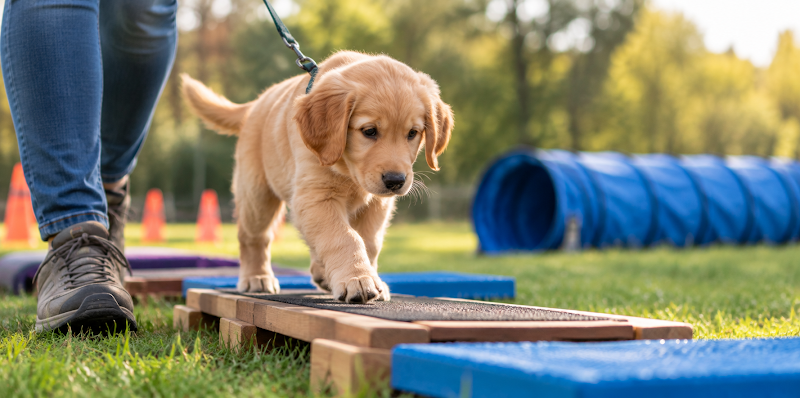
Third, see whether your puppy can still engage with you in a new setting. Can they take a treat? Follow you for a few steps? Look back at you after noticing another dog? Those small responses give an instructor something to work with.
Finally, evaluate the class itself. The best puppy won't benefit much from a poorly managed room.
Before enrolling at a dog training school, ask what actually happens during the session. If possible, observe a class without your puppy first. AVSAB recommends observing how instructors teach, whether students receive individual help, how dogs appear to respond, and whether the trainer uses humane methods. Its guidance on choosing a trainer also recommends looking for instructors who can adapt their approach to individual dogs.
Choosing the right class for your dog's age
The best age to start dog training only matters if the course matches what your dog needs at that point.
A useful first question isn't "Which class sounds the most advanced?" It's "What should my dog be learning next?"
For an eight-week-old puppy, potty routines, crate comfort, handling, attention, social experiences, and very simple obedience may matter most. For a five-month-old puppy, recall and behavior around distractions may deserve more attention. An adolescent dog may need greater structure around leash walking, impulse control, and maintaining learned skills in stimulating environments.
If you're comparing local programs, this guide to choosing a first puppy training class in Metro West goes deeper into class size, structure, trainer qualifications, and what to watch for during group instruction.
Group class, private training, or another format?
Different dog training classes serve different purposes.
A group puppy class can be useful when your dog needs foundational skills while learning around controlled distractions. It also gives the owner practice training with other activity happening nearby.
Private training may make more sense when the problem is highly specific, when a dog is too overwhelmed to learn effectively in a group, or when the household needs individual coaching.
More intensive programs can suit owners who need additional structure, but they still require owner participation afterward. Dogs learn in context. Skills practiced with a trainer have to become part of routines at home if they're going to remain useful.
Once a dog has completed foundational training, continuing dog training services can provide a next step through manners work, obedience practice around distractions, or specialty classes rather than repeatedly restarting at the beginner level.
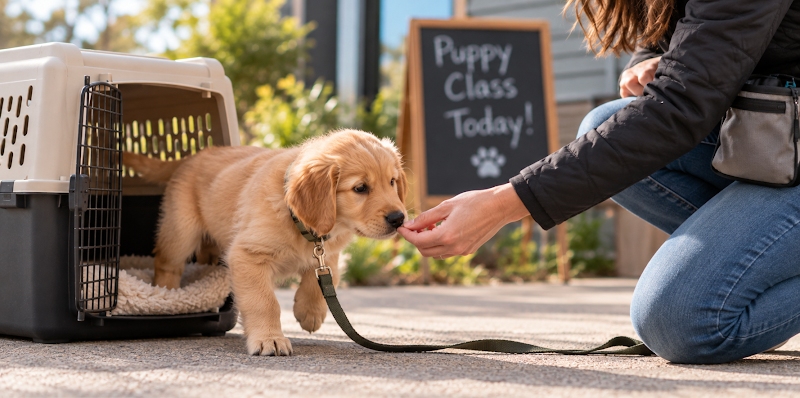
When it can make sense to delay a group class
Starting early doesn't mean every puppy should enter the next available group session.
You may need to adjust the plan if your veterinarian advises against attendance for a health reason, your puppy is ill, or the training facility's vaccination requirements haven't been met.
The class environment itself may also be wrong for a particular puppy. A puppy that spends the entire session hiding, attempting to escape, or unable to recover may need a quieter introduction before returning to group work.
The answer isn't necessarily to stop training. You can continue appropriate skills at home while working with a qualified professional to decide how and when to introduce a more demanding environment.
Start early, then keep building
For most puppies, the best age to start dog training isn't six months or a year old. Learning starts immediately, and a suitable structured puppy class can often begin at around eight weeks when health requirements and veterinary guidance allow.
What matters more than hitting an exact age is choosing training that fits the dog's developmental stage. Start with simple habits, safe positive experiences, and communication. Then increase expectations gradually as your puppy becomes capable of handling more distractions.
A good first class isn't the finish line. It's the beginning of teaching your dog how to learn with you.
FAQs
Is 8 weeks too early to start dog training classes?
Not necessarily. Many structured puppy programs begin at approximately eight weeks, provided the puppy meets the program's health requirements and a veterinarian agrees attendance is appropriate. At that age, classes should emphasize age-appropriate foundations rather than demanding prolonged obedience exercises.
Should I wait until my puppy is fully vaccinated before training?
You don't need to postpone all training and socialization until the full vaccine series is complete. AVSAB supports safe early socialization during the first three months while also recommending appropriate vaccinations and avoiding high-risk environments. Ask your veterinarian about your puppy's health status and local disease risks before attending class.
Can I start training my puppy as soon as I bring them home?
Yes. Household training can begin immediately with simple routines such as potty training, crate familiarization, name recognition, recall games, gentle handling, and rewarding desirable behavior. Keep sessions short and appropriate for a young puppy's attention span.
Is 6 months too late to start dog training?
No. Six months is still a very useful age to begin formal training, and adult dogs can learn as well. A dog starting later may have established habits to work through, so the right beginner program should be based on current behavior and experience rather than age alone.
What should a beginner puppy class teach?
A well-designed beginner class may cover basic obedience, attention to the handler, leash skills, recall, appropriate handling, puppy behavior, and carefully managed social experiences. It should also teach the owner how and when to practice those skills at home.
How long should I train my puppy each day?
You don't need one long training block. Young puppies usually benefit from brief practice woven into everyday routines. A few repetitions before meals, during walks, after potty trips, or during calm play can be more manageable than expecting prolonged concentration.
What if my puppy is scared during training class?
Don't assume that forcing the puppy to stay close to the frightening stimulus will make the fear disappear. Increase distance, reduce difficulty, and allow the puppy time to recover. Persistent or intense fear warrants guidance from your veterinarian or an appropriately qualified behavior professional.